
Load Balancers: The Silent Heroes Keeping the Internet Alive
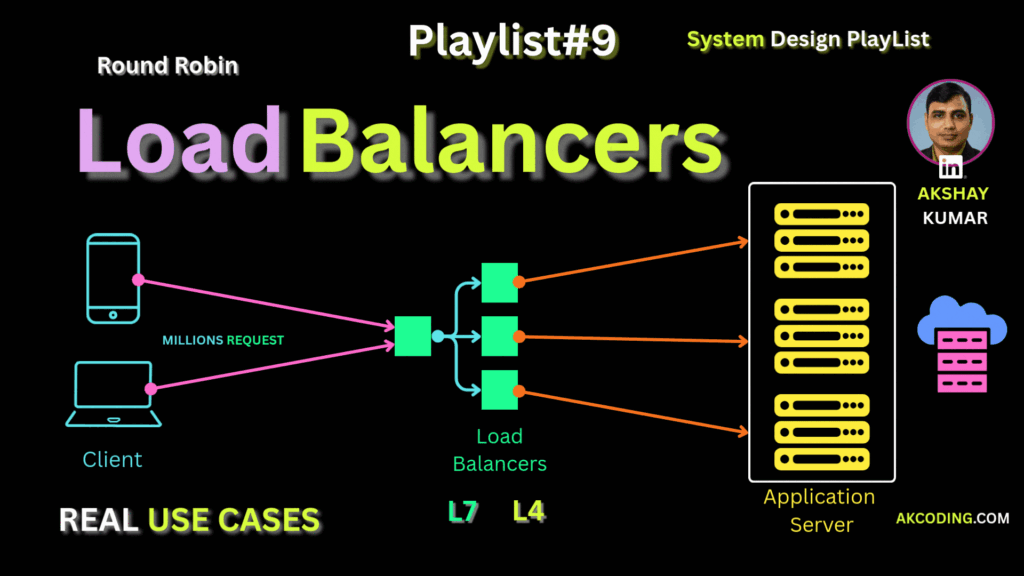
Imagine launching a new feature and suddenly thousands — maybe millions — of users hit your application at the same time.
Your code is perfect.
Your servers are healthy.
Yet… the system crashes.
Why?
Because traffic is uneven, and without control, even the strongest servers fail.
This is where Load Balancers quietly step in — and save the day.
What Is a Load Balancer (Really)?
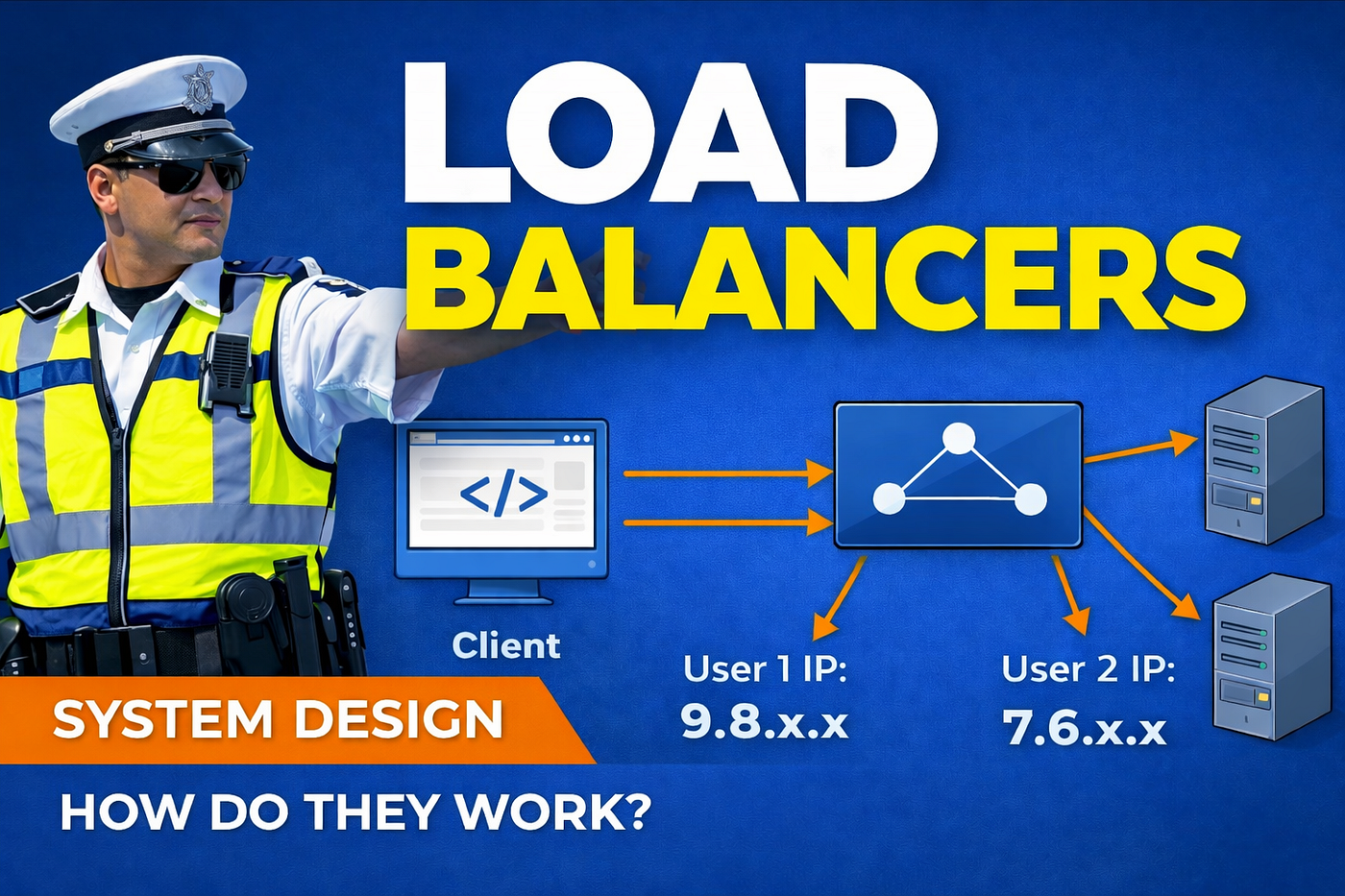
At its core, a load balancer is a traffic manager.
It sits between clients and servers and decides:
“Which server should handle this request?”
Instead of all users hitting one server, traffic is distributed intelligently across multiple servers, ensuring:
- High availability
- Better performance
- Fault tolerance
- Scalability
Think of a load balancer as the traffic police 🚦 of the internet — directing vehicles (requests) so no road (server) gets jammed.
Why Load Balancers Are Non-Negotiable at Scale
Without a load balancer:
- One server becomes overloaded
- Response times spike
- Failures cascade
- Users leave
With a load balancer:
- Traffic spreads evenly
- Failed servers are bypassed
- Systems scale horizontally
- Downtime is minimized
Almost every large-scale system — Netflix, Amazon, Google, Uber — relies heavily on load balancing.
Where Does a Load Balancer Sit?
A typical flow looks like this:
Client → Load Balancer → Backend Servers
Clients never talk directly to backend servers.
They talk to the load balancer, which acts as the single entry point.
This abstraction gives you:
- Freedom to add/remove servers
- Safer deployments
- Zero-downtime scaling
Load Balancing Algorithms (The Brain 🧠)
Not all load balancers distribute traffic the same way. The “how” matters.
1. Round Robin
Requests are distributed sequentially:
Server 1 → Server 2 → Server 3 → repeat
✔ Simple
✖ Assumes all servers are equally powerful
2. Weighted Round Robin
More powerful servers get more traffic.
✔ Better for mixed server capacities
✔ Common in production systems
3. Least Connections
Traffic goes to the server with the fewest active connections.
✔ Ideal when requests have variable processing time
✔ Used heavily in real-time systems
4. IP Hash / Sticky Sessions
Requests from the same user always go to the same server.
✔ Useful for session-based applications
✖ Reduces flexibility
Layer 4 vs Layer 7 Load Balancing
This is a classic system design interview topic.
Layer 4 (Transport Layer)
- Works with IP and TCP/UDP
- Fast and efficient
- No understanding of HTTP
✔ High performance
✖ Less intelligent routing
Layer 7 (Application Layer)
- Understands HTTP headers, URLs, cookies
- Can route based on path, user, or content
✔ Smart routing
✔ Essential for microservices
✖ Slightly more overhead
Most modern architectures use Layer 7 load balancers.
Load Balancers and High Availability
Load balancers don’t just distribute traffic — they detect failures.
Using health checks, they:
- Identify unhealthy servers
- Stop routing traffic to them
- Automatically recover when servers are healthy again
This makes load balancers a cornerstone of high availability architectures.
Popular Load Balancer Examples
- Nginx — Lightweight, flexible, widely used
- HAProxy — High performance, battle-tested
- AWS ALB / NLB — Managed, scalable, cloud-native
- Envoy — Modern, service-mesh friendly
The choice depends on:
- Scale
- Cloud vs on-prem
- Layer 4 vs Layer 7 needs
Common Mistakes Engineers Make
❌ Assuming load balancing = scalability
❌ Ignoring session management
❌ Forgetting health checks
❌ Using sticky sessions everywhere
❌ Not testing failure scenarios
A load balancer is powerful — but only when used correctly.
Why Load Balancers Matter for Your Career
If you’re:
- Preparing for system design interviews
- Designing microservices
- Building high-traffic applications
You must understand load balancers deeply.
Interviewers often don’t ask:
“What is a load balancer?
They ask:
“How would you design a system that handles 10 million users?”
And the answer almost always starts with:
“We place a load balancer in front…”
Final Thoughts
Load balancers rarely get credit.
Users don’t see them.
Product managers don’t talk about them.
But without load balancers, the internet as we know it would not survive traffic spikes.
They are silent.
They are critical.
They are everywhere.
If you master load balancers, you’re one step closer to mastering scalable system design.
Read other awesome articles in Medium.com or in akcoding’s posts.
OR
Join us on YouTube Channel
OR Scan the QR Code to Directly open the Channel 👉